On May 13th, African Women’s Day, Aminatou Daouda Hainikoye, Chef du Projet Mata Masu Dubara à Care-international, appeared in Le Sahel, Niger’s official government newspaper:
Combativité, expérience et réussite d’une activiste acquise à la cause de la femme >>
Senegalese Press, Le Soleil, write-up on the Tufts University GHC Ceremony:
“Saida Oumoulkhairy Niass, ne pouvant pas pu faire le déplacement elle-même pour se rendre aux Etats-Unis pour recevoir le prix, elle a décidé d’envoyer son fils cadet, Sékou Aboubacar Hassoumi. Dans son discours d’acceptation qui sera lu par Sékou Aboubacar Hassoumi, qui est actuellement le directeur de cabinet du ministère des Mines du gouvernement du Niger, Saida Oumoulkhairy Niass va remercier l’Université de Tufts de l’avoir choisie comme première lauréate de ce prix nouvellement créé. Elle confondra aussi dans ses remerciements le Professeur Pearl Robinson, chercheuse engagée, pour le soutien qu’elle apporte à son mouvement, entre autre en réalisant le film documentaire qui va permettre au public nord-américain de la connaitre elle et le mouvement Nassiratu Dine qu’elle a créé.” Read the full text >>
Tufts University Press Coverage:
Mama Kiota, Nigerien Muslim women’s activist, recognized by university 10/26/17
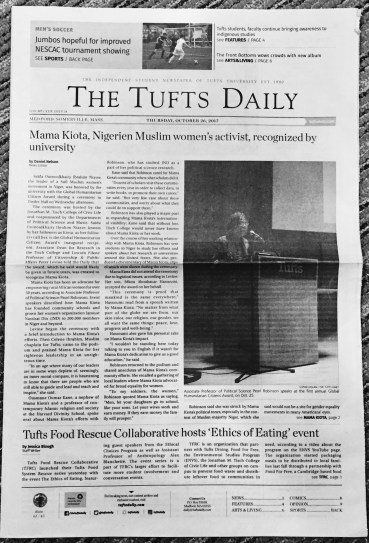 “Saïda Oumoulkhairy Ibrahim Niasse, the leader of a Sufi Muslim women’s movement in Niger, was honored by the university with the Global Humanitarian Citizen Award during a ceremony in Distler Hall on Wednesday afternoon…
[Peter] Levine began the ceremony with a brief introduction to Mama Kiota’s efforts. Then Celene Ibrahim, Muslim chaplain for Tufts, came to the podium and praised Mama Kiota for her righteous leadership in an unrighteous time. ‘In an age where many of our leaders are in some ways deplete of, seemingly, an inner moral compass, it is heartening to know that there are people who are still able to guide and lead and teach and inspire,’ she said.
Ousmane Oumar Kane, a nephew of Mama Kiota’s and a professor of Contemporary Islamic religion and society at the Harvard Divinity School, spoke next about Mama Kiota’s efforts with Robinson, who has studied JND as a part of her political science research.
Kane said that Robinson cared for Mama Kiota’s community when other scholars didn’t. ‘Dozens of scholars visit these communities every year in order to collect data, to write books, to promote their own career,” he said. “But very few care about these communities, and worry about what they could do to support them.’
Robinson has also played a major part in expanding Mama Kiota’s international visibility; Kane said that without her, Tisch College would never have known about Mama Kiota or her work. Over the course of her working relationship with Mama Kiota, Robinson has sent students to Niger to study her efforts and spoken about her research at universities around the United States. She also produced a documentary of Mama Kiota, clips of which were shown during the ceremony.
Mama Kiota did not attend the ceremony due to logistical issues, according to Levine. Her son, Sékou Aboubacar Hassoumi, accepted the award on her behalf. ‘This ceremony is proof that mankind is the same everywhere,” Hassoumi read from a speech written by Mama Kiota. “No matter from what part of the globe we are from, our skin color, our religion, our gender, we all want the same things: peace, love, progress and well-being.’
Hassoumi also gave his personal take on Mama Kiota’s impact. ‘I wouldn’t be standing here today talking to you in English if it wasn’t for Mama Kiota’s dedication to give us a good education,’ he said.
Robinson returned to the podium and shared anecdotes of Mama Kiota’s community efforts. She recalled a gathering of local leaders where Mama Kiota advocated for broad equality for women. ‘To my soldiers, the women,’ Robinson quoted Mama Kiota as saying. ‘Men, let your daughters go to school, like your sons. Let your wives work and earn money. If they earn money the family will prosper.’
Robinson said she was struck by Mama Kiota’s political tones, especially in the context of Muslim-majority Niger, which she said would not be a site for gender equality movements in many Americans’ eyes. ‘Nobody would believe this in America,’ she recalls. ‘I’m here, and even I can hardly believe it.’”
Read the full article at: https://tuftsdaily.com/news/2017/10/26/mama-kiota-nigerien-muslim-womens-activist-recognized-university/
 Mama Kiota's Message