
When I was 19, finishing up my junior year at the University of Bordeaux in a Study Abroad program, a light switched on in my head. At that moment of clarity, I knew what I wanted to do … going forward. I wanted to sped the rest of my life learning about Africa, and sharing that knowledge with other people. I am doing that even today. And my emphasis is still on the learning side of the ledger.
Let me share with you a passage from a letter I wrote to a friend during my first Tufts sabbatical back in 1983. I was in Niger, doing fieldwork Political Participation under a Military Regime:
__________________________ 17 December 1983
“I went to Kiota yesterday. It’s a large rural community that is the home of Niger’s most important Sufi Muslim Cheikh. The night of the 16th and the morning of the 17th of December was Maouloud, the celebration of the Prophet Mohammed’s birthday. There was a festive atmosphere, … people everywhere walking around, visiting, buying and selling. And this is the one night of the year when cloistered women are allowed to walk the streets.
People come by the thousands from all over Niger and neighboring countries on a pilgrimage in order to spend Maouloud in the presence of Cheikh Aboubacar Hassoumi of Kiota. At midnight the marabouts began reading (actually singing) the Qur’an, and the crowd sang in repetition—phrase-by-phrase. This continued until daybreak. Prayers and blessings completed the ceremony at around 7am.
But before joining the throngs of pilgrims who had gathered in front of Kiota’s Grand Mosque, I, along with 2 other people, managed to have a brief audience with Cheikh Aboubacar.
We entered a large roomful of books – in bookcases, on chairs, and stacked on the floor. The Cheikh was dressed all in white: a white boubou, white turban, a white lace veil covered his nose and mouth … white shoes. And large horn-rimmed glasses covered his eyes.
It’s about 98% certain that I’m the only woman he received that evening. He’s a very gentle man. He blessed us and then gave me an autographed photo and a cash gift (about $12) as a token.
I hope to return for an interview when he’s less pressed.”
____________________________________________
Reading these words more than 2 decades later, I realize that the voice is trying to convey ethnographic authenticity. But I had done no research in Kiota. I was simply seeing it through the eyes of my American male escort, who worked for an NGO that was financing one of the Cheikh’s vegetable growing projects. Not until I returned to Kiota in 2003, as the guest of Cheikh Aboubacar’s daughter Zahara, did I realize that 1) I had noted the presence of women, but did not SEE what they were doing; 2) I had simply assumed that these women would normally be out of site; and 3) I took for granted that the person who really mattered in this scenario was Cheikh Aboubacar. I was wrong on all 3 counts.
I had met Zahara in Niamey—Niger’s capital—at a seminar on Islam and Family Law in Niger, hosted by a local human rights organization. At age 26, she was married with two sons, and completing an MA in Education at the Islamic University in Say. A non-Europhone African intellectual and a popular religious preacher, Zahara is able to move seamlessly between French and Arabic, and was Niger’s first female radio presenters speaking on Islamic issues. When I introduced myself as an American Political Scientist beginning a new research project on Interest representation of Women in a Muslim majority Democracy, she invited me to spend Maouloud in Kiota as her guest, and to meet her mother, Saïda Oumul Khairy Niasse. We would stay at Oumul Khairy’s house.
That’s how it started. When I arrived in Kiota in the afternoon of Maouloud, I learned that Oumul Khairy was Cheikh Aboubacar’s fourth and youngest wife. They all lived in a huge family compound. But unlike her co-wives, she had her own, 2-story house. Hundreds of people surrounded the house. Some were trying to push their way into her a large receiving room, where she met with guests. Others were hoping to get a glimpse of her. Some were content to simply be in her presence. Everybody referred to her as “Mama Kiota”—the Mother of Kiota.
I got my first glimpse of Mama Kiota when she emerged from the bedroom and living room section of her house to enter the large receiving room on the second floor. After brief introductions by Zahara, Mama explained that she would be busy with her religious work until the next morning. Then she invited me to return to Kiota the following month, when her women’s association, the Jamiyat Nassirat Dine, would be holding a “Congress.” She told me that the theme would be “The Role of Muslim Women in the World Bank’s Poverty Reduction Program for Niger.”
I must admit that this was the last thing I expected her to say. But I graciously accepted the invitation. At that point, I didn’t understand what these women were doing. But I was fascinated! … I knew it was politics. And I decided to study it.
I am now completing a documentary entitled MAMA KYOTA! It examines the life and work of Saïda Oumul Khairy Niass, whose father, Cheikh Al Tariqa Ibrahim Niass of Senegal, was the most important West African Sufi Muslim scholar of the 20th century. Cheikh Aboubacar of Kiota was a disciple of Ibrahim Niass. And his union with Oumul Khairy was a strategic marriage arranged to facilitate the spread of the Niass branch of Tidjanism among women in Niger.
The movie’s mixed media format combines contemporary and historical images with audio clips of Tidjani religious music, praise songs and poetry; video clips of community life; public oratory; and personal testimonies—together with a narrative that explains how Mama Kiota illuminates Islam through her efforts to enhance personal agency in the lives of Muslim women.
Mama Kiota’s extraordinary political skills are on display—whether addressing rural farmers in a millet field, intimately counseling a group of women in her bedroom, speaking to a crowd of thousands at a large Sufi rally, or striding down Kiota’s main street with the mayor and the US Ambassador at her side. She deploys a mix of spiritual authority, religious knowledge, cultural capital and kinship ties to leverage financial resources and training opportunities for women and girls. She has established schools that offer religious and secular education to girls and boy, and teaches women their rights under Islamic law. She promotes a pragmatic development agenda, targets female illiteracy and encourages women to acquire property in their own names.
In 1994 Mama Kiota established the Jamiyat Nassirat Dine, a Tijani women’s movement with 200,000 members in Niger and branches in 6 West African countries The JND is a multi-ethnic, transnational, overwhelmingly rural African women’s association whose members range from adherents with no formal education other than basic Islamic knowledge, to university graduates trained at both Western and Islamic institutions. The association claims a membership of over 200,000 women in Niger, and with branches in 6 West African countries.
The JND held its first public policy congress in 1998. The theme: The Rights and Responsibilities of Muslim Women in Educating the Young. Four more have followed:
2003: The Role of Muslim Women in the Fight against Poverty in Niger
2007: Women, Peace and Sustainable Development in Niger
2011: Solidarity and Reconciliation in Niger
2015: The Contribution of Sufism to Peace
Typically, documentary films are pitched to niche markets. However this project aims to influence the perception of Muslim women PRIMARILY in African popular culture and Islamic popular culture. Its digital content will be exported in a web version, a computer version and a DVD. At Mama Kiota’s suggestion, the movie is narrated in Hausa, the most widely spoken West African language. Soundtracks are planned in English, French, Swahili and Arabic. Targeted audiences include the markets for Sufi religious goods (around mosques, pilgrimage sites, Sufi festivals); video entertainment markets (personal consumers, video viewing parlors, intenerate rural market rentals, fast food franchises); mobile movies (video buses); online sites (YouTube, Vimeo, Islamic feminist websites); as well as academic markets (African language programs, religious studies, women and gender studies).
When I sat down with Mama Kiota to go over the storyboards for “our” documentary, the JND had just finished its fourth Policy Congress. I was showing Mama how I planned to incorporate scenes from the Policy congresses into the movie. A slight smile crossed her lips. She was clearly pleased. Then she leaned forward and said, “Now, I’m ready to do politics.”
That reminded me of something she had said to me several years earlier, after I showed her a PowerPoints that featured pictures of some of the JND women: “Forty years, 40 years I’ve been doing this work. And you’re the first person who has understood what I’m really trying to do.”
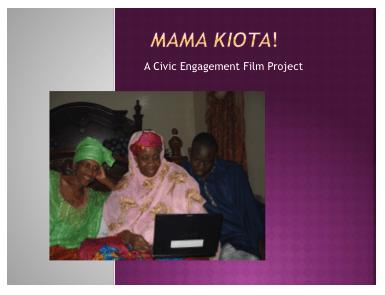
(April, 2015)

 Mama Kiota's Message