
READ? … WHAT WOULD SOMEBODY LIKE ME DO WITH THAT?
BIRNI N’ KONNI, NIGER August 10th, 2016
What a day! … What a night!
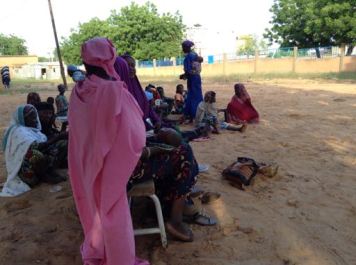 I organized a screening in Birni ‘n Konni around my personal interest in responses to the problem of present-day slavery in Africa. On the nearby cliffs overlooking Konni are 3 small villages where women recently freed from slavery reside. Birni ‘n Konni is also the site of a large Tidjaniyya zawiya (a Sufi lodge, place of religious instruction, and mosque headed by a local Khalif). Here I faced the challenge of accommodating the interests, needs and spatial relationships of two diverse communities. The solution ultimately required showing the movie twice.
During my time as a Peace Corps volunteer in Niger I learned that slavery was still being practiced among several of the country’s ethnic groups in scattered locations—including Madoua, where I lived and worked for two years (1968-70). Although abolished in 1960, and prohibited in 1999, enslavement was not penalized in Niger until 2003. Vestiges of the practice linger. Presently, the majority of Nigeriens attached to families by bonds of servitude are invisible women subjected to hard labor, threats, and humiliation, while bearing children fathered by their “masters.” Timidria, Niger’s leading anti-slavery and human rights NGO, gets credit for successfully lobbying parliament to pass a law criminalizing the practice of slavery. Upwards of 300 Nigerien captives have since been liberated.
Four years ago I met Hadijatou Mani, Niger’s most famous ex-slave. She and her young child live in the Konni highlands, while her new husband had joined the labor exodus to Nigeria. I was distressed to find that emancipation had done so little to broaden Hadijatou’s personal horizons. It seemed that no one was encouraging her to acquire new skills. I introduced myself as an African-American teacher, and asked if she wanted to learn how to read. We spoke in Hausa. The conversation went as follows:
HM: Read? What would somebody like me do with that?
PTR: Have you ever heard of Mama Kiota?
HM: Yes.
PTR: I’m making a movie about Mama Kiota. There are women in the movie who never went to school. Mama Kiota arranged classes so they could learn how to read and write Zarma (their local language). Now they are running their own credit association. It loans money to more than 300 people.
HM: (She threw her head back, and looked toward the sky.) That would be a reason to learn how to read. If I could do something like that, I might want to learn to read.
PTR: When my movie is finished, I’ll make sure you see it.
Making good on that promise wasn’t easy. But with help from Timidria staffers, Hadijatou was one of 45 formerly enslaved women transported from the Konni highlands to see the MAMA KYOTA movie.
Once the Timidria women were settled, I visited Halifa Sani Idrissa, head of the Tidjaniyya zawiya in Konni. He is an uncle to the movie’s Hausa narrator, Rakiatou Hama, who accompanied me. Their relationship eased the conversation. Sitting on a mat with the Halifa and two of his advisors, we listened as he explained the ground 2 rules: Tidjaniyya women don’t go out at night without their husbands’ permission; they require separate seating from the men; and the Meeting Room at the Prefecture is the only suitable venue in Konni if you want our women to attend.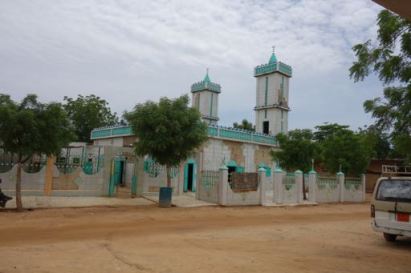
The Halifa took responsibility for providing minibuses to transport the Tidjaniyya women to the Prefecture. No need for further discussion. Halifa Sani and I set show-time for 7:30pm. We agreed the women would arrive by 7pm. The men would come later, after completing their final religious rituals for the night. Rakia informed her uncle that 45 Timidria women from the Konni highlands would be attending the screening as well.
The Prefecture’s Meeting Room seats 300. The Timidria women were in place an hour early, and word-of-mouth quickly drew a crowd of about 200. At 7:30pm no one from Konni’s Tidjaniyya community had arrived. Shortly before 8pm, I gave the gave the signal to start rolling.
All eyes fixed on the screen as Mama Kiota addressed a group of farmers in a millet field, told men to send their daughters to school, and blessed a rural mosque. Images of iconic Tidjani saints, women running their own credit association, and popular Zikr singers evoked comments. People listened as the movie’s narrative documented the history of the Tidjaniyya women’s movement in Niger. During the final 10 minutes, children, women and men (about 250 in all) began streaming into the hall. Enthusiastic but disruptive, the local Tidjaniyya community joined the scene. I stopped the movie briefly, announced there would be a second screening, and asked the latecomers to wait in the back or outside until the break.
A short open mike session followed the screening. All who spoke were from the Timidria women’s group. Their comments were earnest and revealed a new sense of self:
- I liked Mama Kiota’s message. How can we start one of her groups in our villages?
- I want “ilimi” (knowledge), literacy, opportunities for my children.
- I want to use a grinding machine for millet. I’m tired of pounding millet into flour byhand. It’s very hard.
- I want to be able to earn money. I’m tired of being poor!
- We’re tired of people bringing us down from the hills and telling us what to do. They don’t listen to what we want for ourselves.
Some of the women remained silent. Others shook their heads approvingly. But this was not the same group of soft-spoken women who greeted me 5 hours earlier. What they will do with these new thoughts and this new-found sense of agency remains to be seen.
The second screening finished after 11pm. The audience had grown to over 300. With words of praise for the documentary, Halifa Sani expressed appreciation for the research I’d done. The final question came from an articulate young woman who spoke directly to me:

MI: I want to know something about the person who made this movie. Who is she? Why this subject? I was one of Mama Kiota’s Talibe. I lived in Kiota for a while. How did she come to know so many things about Mama Kiota that I never knew?
PTR: I’m a Political Scientist. I’ve spent 13 years studying how Mama Kiota works to empower women.
Malama Inayatou, my curious questioner, ordered 40 copies of the DVD. She’s a teacher in Birni n’ Konni, and plans to use the MAMA KYOTA video in her educational work with young women and girls.

 Mama Kiota's Message