
ALL MY FILMS HAVE A POLITICAL DIMENSION (1)
TAHOUA, NIGER August 10th, 2016
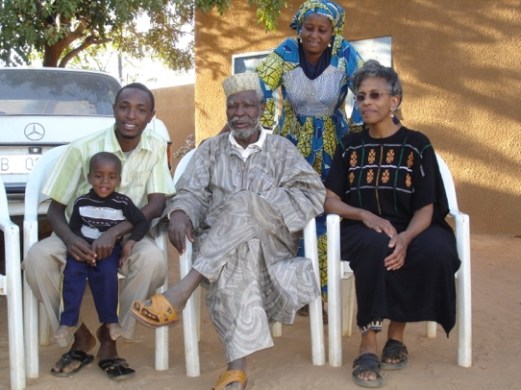
I had imagined Tahoua would be an exciting venue. It’s Niger’s second largest city—where my movie’s editor, my movie’s editor, Moustapha Alassane, lived and worked for more than 40 years. Moustapha was a pioneering African filmmaker. Widely hailed as a creative genius, he received 26 major international awards (including the French Legion of Honor @ Cannes 2007). We spent many hours together in his Tahoua studio, occasionally musing about our MAMA KYOTA movie launch. A seasoned veteran of the film festival circuit, Moustapha believed that a serious African filmmaker should provide opportunities for African audiences to reflect on the customs and conditions of their societies. Commenting on his own work, he explained, “All my films have a political dimension.”
Sadly, a paralyzing stroke ended Moustapha’s life before our job was done. His son AbdoulWahab, our assistant editor, worked with me to complete the project. Without Moustapha’s commanding presence, the Tahoua screening morphed into a strictly Tidjaniyya social event presided over by male religious elders. Still, Moustapha’s vision pushed its way through. His skillful editing wove together a montage of sounds and images to create a compelling narrative that captivated the audience and spoke to all in attendance. Viewers’ comments during the subsequent open mike session were a testament to the documentary’s power to challenge prevailing assumptions about Islam’s limitations on the roles of women and the extent of women’s contributions to community life.
Tahoua’s location at the southern edge of the desert makes it a gateway for trans-Saharan trade. The city is also a magnet for thousands of West African migrants, desperate to cross the Sahara in search of a better life in Europe. Never mind that few survive. Huge numbers of unemployed young men—in some cases joined by women and children—take the risk. These wayfarers become prime targets for human traffickers, or for recruitment by terrorist networks that can offer a cash income, or the promise of glory as a foot soldier for Islamic Renewal.
Niger shares a border with Libya, and the overthrow of strongman Muammar Gadaffi in 2011 had dire consequences for the neighborhood: a refugee crisis, a surge of small arms flows, and the proliferation of radicalized Islamic groups. Tidjaniyya leaders from as far away as Senegal are working to stem lethal attractions by strengthening bonds of solidarity among co-religionists. I met El Hadji Moussa Sow of Kaolack, one of the actors in this drama, while in Tahoua. He bought a copy of the MAMA KYOTA movie, and will carry it to Senegal.
Fortunately, my most vexing problem in Tahoua was a brush-up with petty corruption in the Mayor’s office. I went to City Hall with Halifa Ibrahima, a senior leader of Tahoua’s Tidjaniyya zawiya, to rent a room for an indoor screening. The Mayor was out of town, and the building lay quiet. Halifa and I were directed to the office of the Commissaire in charge of scheduling the Meeting Room. His door was open, we entered, and found him on the floor—asleep on a mattress behind the desk! We managed to wake him, only to realize he was in a drug-induced stupor. Halifa looked horrified. The Commissaire fumbled for his cellphone, made a call, and a man with a set of keys arrived to show us the facilities. The Meeting Room met all the specs for our equipment and could seat 150 people. Ready to seal the deal, we returned to the Commissaire’s office.
On the way back, a large man in a handsomely embroidered boubou met us in the hallway, introducing himself as Chief-of-Cabinet for the City Council. When I told him we were renting the Meeting Room for a film show, he shouted, “That’ll cost you 100,000 CFA!” In measured tones, Halifa said that the price is 80,000 CFA; he had checked in advance. The official barked back: If you want to rent the room, you must pay 100,000
CFA. We looked him in the eye, and stared back. Finally, the stand-off ended. The Cabinet Chief sucked his teeth, looked away, and sent us to the Commissaire’s office to finalize the payment. Halifa Ibrahim was disgusted.
Show-time was set for 8pm, but heavy rains forced a delay. Tahoua is a largely mud brick city, where most households cook with firewood. The rains slow food preparation, and it is unthinkable that a woman would leave home to see a movie without first feeding her family. So Halifa Ibrahima and I sat together in the Meeting Room at the Mayor’s office … and waited.
Out of the blue, my phone rang. It was the Commissaire, calling to say that he had forgotten to tell me about the requirement to hire 2 security guards for my event. He explained that these are private contractors who don’t work for the Mayor’s office. He had taken the liberty of contacting two men, and they were waiting for me outside the building. According to the Commissaire, I had to pay them in advance.
I went outside and found two helmeted young men standing beside big, shiny motorcycles. They cut to the chase—warning that without proper security, somebody might break in and disrupt the event. It was up to me to decide how much I would pay. They refused to set a price. I then asked about a receipt to document the payment. Their response: Only the Commissaire gives receipts. So I got the Commissaire back on the phone. The dialogue was scripted: I’m at home. The office is closed. You’ll have to return tomorrow to pick up the receipt.
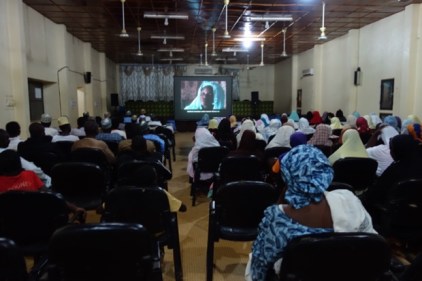 That ended the conversation for me. I told the wanna-be security guards, No receipt for me tonight, no money for you. They looked at each other, looked at me, then got on their
motorcycles and drove away. I was nervous for about an hour. I thought about the Sultan of Sokoto, who told the Wilson Center audience that crooked officials were strengthening the hand of Boko Haram. Slowly … remembering Moustapha … I re-focused on the task at hand as a steady stream of movie-goers began to fill the room.
Around 9:15pm Halifa Ibrahim opened with a few words of welcome. Mama Kiota had phoned him that afternoon to ask that he encourage people–especially women—to come and see the kind of work she has been doing. Lights dimmed. At last, we were ready to roll.
As in Kiota and ‘Konni, the audience was captivated by the narrative of Mama Kiota’s life. As they say in Hausa, “Heads opened up” to absorb new knowledge about the Sufi master Ibrahim Niasse; about Cheikh Aboubacar Hassoumi and the origins of Kiota; about Oumul Khairy Niasse—her childhood, her education in Senegal, her marriage to Cheik Aboubacar of Kiota—and about the remarkable accomplishments of the rural and urban Tidjaniyya women she has mentored and inspired.
The message came through loud and clear. Mama Kiota is like a book; her life teaches lessons. She hails from a prominent religious family, and is a highly respected spiritual leader on her own right. Speaking with religious authority, she promotes a pragmatic development agenda, targets female illiteracy, touts poverty alleviation, and prioritizes activities crucial for women’s well-being.
When the movie ended, Halifa Ibrahim picked up the mike. Speaking directly to the audience, he reflected on how the documentary had expanded his understanding of the teachings of Nassine Tidjanism. It made him think, and he encouraged others to follow suit.
A female preacher was next to speak. Rather than address the movie, she focused on a woman’s duties in Islam—stressing the importance of marriage and obedience to her husband, and being a good homemaker. I worried that the preacher lady might be undercutting Mama Kiota’s message of female empowerment. Yet I was pleased that the forum facilitated the free flow of multiple voices around a discussion about social customs and conditions.
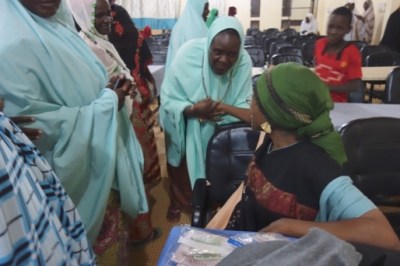 The event finished around 11pm. As the crowd filed out, some of the women walked over to greet me. Each shook my hand, and thanked me for sharing the knowledge. Several purchased DVDs of the movie. Others told me if we had advertised the price in advance, they would have come with enough money to buy the video as well. I’ll keep that in
mind for future screenings.
The security situation in Tahoua is precarious. Indeed, it may well be the riskiest venue of the entire movie tour. But thus far, Fate has smiled on us. And I truly believe that Mama Kiota’s blessings (Baraka) are enveloping our journey in a patina of peace and spiritual protection.
(1) Moustapha Alassane, quoted in Abderrahmane Sissako, “Mustapha Alassane: Hommages et rétrospectives,” Paris Cinéma: 29 Juin®12 Juillet 2005, p. 85.

 Mama Kiota's Message